First, let me give a shout out to Butterfly and her wonderful thread that has inspired this post and given me the courage to share my ideas. Secondly, this is not meant to be universal, and I will repeat myself on occasion cause this topic is extremely important to me and I feel certain aspects need extra emphasis. In this post I will discuss some of the most common safewords and what they mean. As mentioned earlier, just cause these are common does not make them universal. They can be a good default or starting place, but never assume your partner will recognize them or that someone in dungeon/club will. If you plan to engage in a scene that has the possibility of needing a safeword, discuss it with your partner before hand. Also, safewords should always be available to both the Dom and Sub in a scene. They are not just for one or the other and should be utilized by both anytime they feel the need. In my personal opinion it is better to stop a scene early and discuss, then to keep going and have something negative transpire.
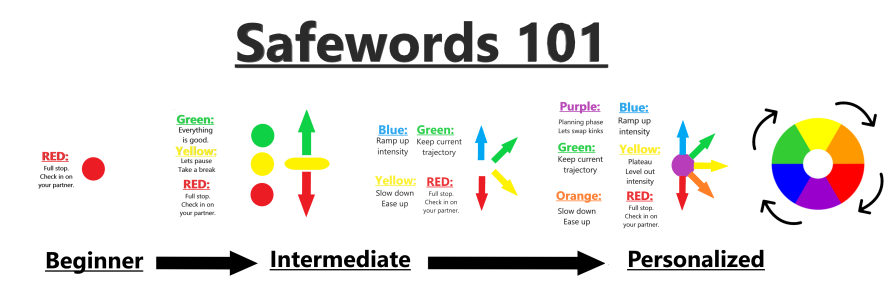
Below is an image I made that shows the basic progression of safewords and how they can evolve over time.

So first lets start with the one most of you will already know RED. This is probably the most common safeword that is recognized by the most people in the community. Whether it is stated by the Dom or the Sub it means the scene is over and it is time for aftercare and to clean up. The reason I gave this one a whole section on itself is cause a lot of folk will use it as the only safeword in a scene. They do not see the need or have the want to make things any more completed then stop and go. Something isn't exactly how it is supposed to be, lets stop and discuss it and evaluate if we should continue.
Next you have what is typically called the Traffic light system. Green Yellow Red It is called this cause they follow the same rules as when driving. With more intense scenes it can sometimes be hard to find words in the moment to convey desire, and that's where this system comes into play. These words are not only for safety, but also to convey as much information as quick as possible. This helps to minimize the disruptions during a scene and keep the flow going.
Green normally isn't used unprompted, but is a response when a partner checks in. It is used to convey that you are doing ok and want to continue. That nothing is amiss and there isn't anything you want to change.
Yellow is for if something needs addressing, but you do not want to stop the scene. It can be a little more nuanced depending on what is going on and should have a bit of deliberation ahead of time. In most of my experiences it is used to signify or convey lower intensity. Flogging or spankings are a great example here. If the Dom is ramping up and does a hit that is just past what you enjoy, you can use it to let them know you want them to reign it in a bit. This does not mean they did anything wrong or that anyone is upset, but to convey the desire to be at a lower level.
Red yes, we have already discussed this one and what it means, but I will repeat it as much as I need to because it is that important. If you hear this, whatever scene is going on needs to be stopped. This is a cease and desist, we are done. As with yellow though, this does not mean that anything wrong happened. It can even be the goal of a scene to reach that point, to try and push yourself further and find out where your limits are, but as soon as it is said, the scene is over and aftercare begins.
The rest of the image is the process of personalization and is my personal preference. Blue is the first word I learned in addition to the Traffic Light system. In my experiences it has been called the Brat word. It isn't so much a safety word, but a way to say you want more. If you look in the center of the image you will see the Blue arrow pointing straight up now while the Green one is angled. This is to emphasize the difference in increase that you desire. Where Green means you want to continue at the same gradual pace you are at, Blue means you want a sharp increase in intensity. This one is much less common, and as with Butterfly's post, it means something very different to her. This is a very good example as to why they need to be discussed. If me and her were in the same scene together we would interrupt it differently if we had not discussed it ahead of time.
The very last bit is the premise of what I call my Scene/Safety Circle. This is a composition of safewords and what they mean to me when I am in a scene. I will never expect anyone to just know these and will always bring them up if I feel like they may become prevalent at anytime during play. I will go into brief detail as to what each of them mean, but if you want a more detailed explanation I explain it better here.
For me a scene starts in the Purple section of a color wheel. This stage is prep work and aftercare. If it is used during a scene it means that I want to swap kinks. It isn't that anything is wrong or needs addressed, but maybe that location is to sore, or my leg fell asleep in that position, or there is something I suddenly have the feral desire to do and want to discuss it. From there we go into Blue, this phase is the beginning or the start of a scene. If I feel the need to use it in a scene it means we have not reached my starting point yet so we need to either ramp things up or maybe switch to something else. In other words, hit me harder. Next we ramp up with Green, this is the progression to get the scene were we want it to be. It means I enjoy what we are doing, but don't slow down, don't stop keep going at this pace. Now this is where my personal words differ from the systems I mentioned previously. Yellow for me is the meat of a scene. This is where I want to be, what I want to experience, keep it right here for as long as we can. We all get tired worn out eventually though and that is where Orange comes into play. It is the part of a scene where we start to wind down and ease up and it means exactly that if used mid scene. Ease up, slow down, back up just a tad. And then we reach the end of a scene Red. As before this is when we stop, the end of the scene, the finish line before we cycle back into Purple for the aftercare and clean up. To clarify one thing, these words are not desired to be used. They are there in case they are needed, not because they are. A perfect scene will progress from prep work to clean up with out either of us ever having to utter them, but just in case we feel the need, we have them available.
Below is an image I made that shows the basic progression of safewords and how they can evolve over time.
So first lets start with the one most of you will already know RED. This is probably the most common safeword that is recognized by the most people in the community. Whether it is stated by the Dom or the Sub it means the scene is over and it is time for aftercare and to clean up. The reason I gave this one a whole section on itself is cause a lot of folk will use it as the only safeword in a scene. They do not see the need or have the want to make things any more completed then stop and go. Something isn't exactly how it is supposed to be, lets stop and discuss it and evaluate if we should continue.
Next you have what is typically called the Traffic light system. Green Yellow Red It is called this cause they follow the same rules as when driving. With more intense scenes it can sometimes be hard to find words in the moment to convey desire, and that's where this system comes into play. These words are not only for safety, but also to convey as much information as quick as possible. This helps to minimize the disruptions during a scene and keep the flow going.
Green normally isn't used unprompted, but is a response when a partner checks in. It is used to convey that you are doing ok and want to continue. That nothing is amiss and there isn't anything you want to change.
Yellow is for if something needs addressing, but you do not want to stop the scene. It can be a little more nuanced depending on what is going on and should have a bit of deliberation ahead of time. In most of my experiences it is used to signify or convey lower intensity. Flogging or spankings are a great example here. If the Dom is ramping up and does a hit that is just past what you enjoy, you can use it to let them know you want them to reign it in a bit. This does not mean they did anything wrong or that anyone is upset, but to convey the desire to be at a lower level.
Red yes, we have already discussed this one and what it means, but I will repeat it as much as I need to because it is that important. If you hear this, whatever scene is going on needs to be stopped. This is a cease and desist, we are done. As with yellow though, this does not mean that anything wrong happened. It can even be the goal of a scene to reach that point, to try and push yourself further and find out where your limits are, but as soon as it is said, the scene is over and aftercare begins.
The rest of the image is the process of personalization and is my personal preference. Blue is the first word I learned in addition to the Traffic Light system. In my experiences it has been called the Brat word. It isn't so much a safety word, but a way to say you want more. If you look in the center of the image you will see the Blue arrow pointing straight up now while the Green one is angled. This is to emphasize the difference in increase that you desire. Where Green means you want to continue at the same gradual pace you are at, Blue means you want a sharp increase in intensity. This one is much less common, and as with Butterfly's post, it means something very different to her. This is a very good example as to why they need to be discussed. If me and her were in the same scene together we would interrupt it differently if we had not discussed it ahead of time.
The very last bit is the premise of what I call my Scene/Safety Circle. This is a composition of safewords and what they mean to me when I am in a scene. I will never expect anyone to just know these and will always bring them up if I feel like they may become prevalent at anytime during play. I will go into brief detail as to what each of them mean, but if you want a more detailed explanation I explain it better here.
For me a scene starts in the Purple section of a color wheel. This stage is prep work and aftercare. If it is used during a scene it means that I want to swap kinks. It isn't that anything is wrong or needs addressed, but maybe that location is to sore, or my leg fell asleep in that position, or there is something I suddenly have the feral desire to do and want to discuss it. From there we go into Blue, this phase is the beginning or the start of a scene. If I feel the need to use it in a scene it means we have not reached my starting point yet so we need to either ramp things up or maybe switch to something else. In other words, hit me harder. Next we ramp up with Green, this is the progression to get the scene were we want it to be. It means I enjoy what we are doing, but don't slow down, don't stop keep going at this pace. Now this is where my personal words differ from the systems I mentioned previously. Yellow for me is the meat of a scene. This is where I want to be, what I want to experience, keep it right here for as long as we can. We all get tired worn out eventually though and that is where Orange comes into play. It is the part of a scene where we start to wind down and ease up and it means exactly that if used mid scene. Ease up, slow down, back up just a tad. And then we reach the end of a scene Red. As before this is when we stop, the end of the scene, the finish line before we cycle back into Purple for the aftercare and clean up. To clarify one thing, these words are not desired to be used. They are there in case they are needed, not because they are. A perfect scene will progress from prep work to clean up with out either of us ever having to utter them, but just in case we feel the need, we have them available.
Attachments
Last edited: